Overview
wcswatin provides workflows to prepare weather and climate time series from gridded and station data for the Soil and Water Assessment Tool (SWAT). It supports data extraction, aggregation, interpolation, quality control, unit conversion, and export of per-location model input files.
The package provides two complementary workflows:
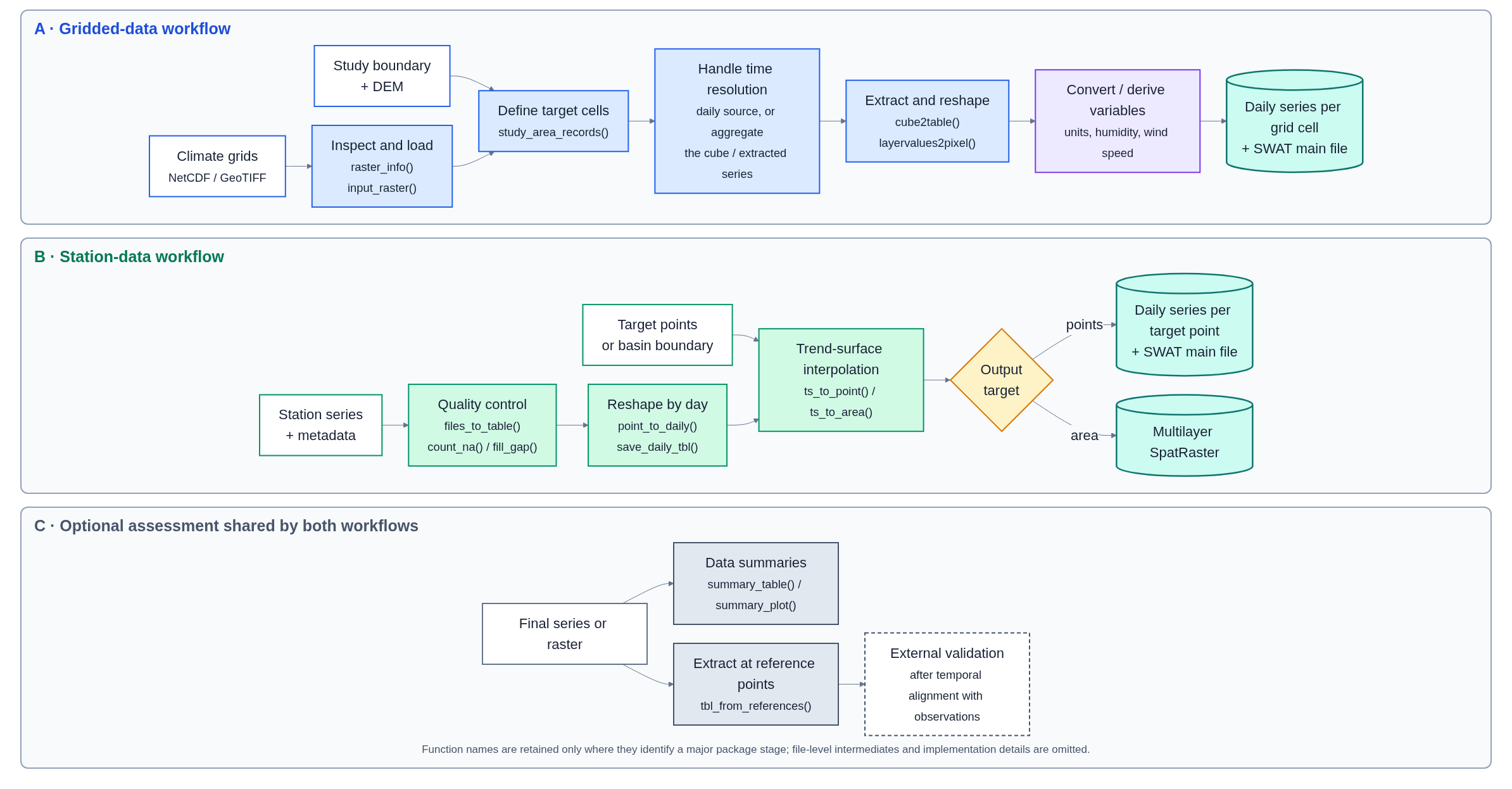
- Raster/NetCDF processing: inspect NetCDF or GeoTIFF files, define study-area cells, extract gridded values, aggregate hourly or daily data, and write SWAT-style time-series files.
- Station data interpolation: read station files, fill gaps, reorganize daily observations, interpolate values with trend surfaces, and write point-based SWAT inputs.
Developed with funding from the Critical Ecosystem Partnership Fund (CEPF).
Key Features
- Inspect NetCDF variables, units, extents, layer counts, and time resolution with
raster_info()andvar_names() - Process NetCDF and GeoTIFF raster files from climate data providers such as ERA5-Land, GPM IMERG and PERSIANN
- Extract gridded data for watershed cells or reference points
- Support hourly workflows, daily NetCDF products, and local datacube aggregation with
datacube_aggregation() - Use
future-based parallel extraction throughcube2table() - Prepare SWAT-style weather files and station interpolation outputs
- Fill gaps and summarize station or gridded time series
Installation
Install the released version from CRAN:
install.packages("wcswatin")To install the development version from GitHub:
# install.packages("remotes")
remotes::install_github("reginalexavier/wcswatin")
Quick Start
library(wcswatin)

# Inspect a downloaded NetCDF file before choosing the processing route
nc_file <- system.file(
  "extdata/nc_data/hourly_multi_2days_2025.nc",
  package = "wcswatin"
)

raster_info(nc_file)
var_names(nc_file)

# Load a raster cube and extract values at reference stations
daily_nc <- system.file(
  "extdata/nc_data/daily_2m_temperature_daily_maximum_2025.nc",
  package = "wcswatin"
)
stations_file <- system.file(
  "extdata/pcp_stations/pcp.txt",
  package = "wcswatin"
)

station_values <- tbl_from_references(
  raster_file = input_raster(daily_nc),
  ref_points = stations_file,
  prefix_colname = "t2m"
)

head(station_values)

# Interpolate daily station tables to target points
interpolated_points <- ts_to_point(
  my_folder = "path/to/station_files",
  targeted_points_path = "path/to/centroids.shp",
  poly_degree = 2
)

ts_point_to_files(
  points_list = interpolated_points,
  output_folder = "path/to/swat_pcp",
  file_prefix = "pcp"
)

Main Functions
Data Input & Inspection
-
input_raster(): Load NetCDF or GeoTIFF files as SpatRaster objects -
input_table(): Load tabular data with validation -
input_vector(): Load spatial vector data (shapefiles, etc.) -
raster_info(): Summarize raster variables, units, dates, and dimensions -
var_names(): List available variables in NetCDF files
Raster/NetCDF Processing
-
study_area_records(): Extract grid points within watershed boundaries -
main_input_var(): Create SWAT main files for gridded variables -
cube2table(): Convert raster data cube to tabular format -
layervalues2pixel(): Write one time series for each grid cell -
datacube_aggregation(): Aggregate or select daily layers before extraction -
daily_aggregation(): Aggregate hourly SWAT-style files to daily files -
tbl_from_references(): Extract raster values at reference points
Station Data Processing
-
files_to_table(): Consolidate multiple station files into a single table -
table_to_files(): Split consolidated data back into individual files -
fill_gap(): Fill missing data using correlation methods -
point_to_daily(): Import and organize daily station data -
save_daily_tbl(): Save daily tables in SWAT format -
ts_to_point(): Trend surface interpolation to specific points (watershed centroids) -
ts_point_to_files(): Savets_to_point()outputs as SWAT-style files -
ts_to_area(): Trend surface interpolation to create continuous raster surfaces
SWAT-Specific Functions
-
var_main_creator(): Generate SWAT input metadata tables -
main_input_var(): Create main variable input tables for SWAT -
rh_calculator(): Calculate relative humidity from other variables -
windspeed_calculator(): Calculate wind speed from components
Data Analysis & Utilities
-
count_na(): Check data completeness and missing values -
summary_table(): Generate statistical summaries -
summary_plot(): Visualize data distributions -
unit_converter(): Convert between measurement units
Data Requirements
The package works with spatial data in WGS 84 geographic coordinate system (EPSG:4326), which is the standard format for most climate datasets. Reference point tables should include NAME, LAT, and LON columns. When possible, vector reference points are projected to the raster CRS before extraction.
For NetCDF inputs, inspect time metadata before processing. Hourly files can be processed through cube2table() and later aggregated with daily_aggregation(), while daily NetCDF products can often be extracted directly. For accumulated products timestamped at a specific hour, datacube_aggregation(mode = "value_at_hour") and daily_aggregation(mode = "value_at_hour") make that convention explicit.
Documentation
- Get started: https://reginalexavier.github.io/wcswatin/articles/wcswatin.html
- ERA5-Land hourly to SWAT case study: https://reginalexavier.github.io/wcswatin/articles/era5-land-hourly-to-swat.html
- Station interpolation workflow: https://reginalexavier.github.io/wcswatin/articles/station-interpolation-workflow.html
- Running a similar case study: https://reginalexavier.github.io/wcswatin/articles/reproducing-the-case.html
- Function reference: https://reginalexavier.github.io/wcswatin/reference/index.html
NetCDF files can be downloaded with any CDS workflow. The optional cds-downloader CLI can help create repeatable CDS download requests, but it is not required by wcswatin.
Getting Help
- Bug Reports: GitHub Issues
-
Contact:
- Réginal Exavier: reginalexavier@rocketmail.com
- Peter Zeilhofer: zeilhoferpeter@gmail.com
Citation
To obtain the current citation in R, run:
citation("wcswatin")If you use wcswatin in your research, please cite:
Exavier R, Kawakubo F, Zeilhofer P (2026). wcswatin: Weather and Climate Inputs for ‘SWAT’. doi:10.32614/CRAN.package.wcswatin. R package version 0.2.0, https://CRAN.R-project.org/package=wcswatin.
Acknowledgments
This project is funded by the Critical Ecosystem Partnership Fund (CEPF).